

Teresa Swinton, CEO at GRIT shares her viewpoint on S.I.F
Recently the term S.I.F. (Serious Injuries and Fatalities), has crept into our ‘safety’ vocabulary and many of our clients are talking about it, particularly those based in the USA.
S.I.F Programs – What We Know
To those of us who have been around the block a few times, this isn’t something new, In the UK and across Europe we have been talking about ‘High Potential’ events for many years, but like all sexy acronyms S.I.F. is gaining some focus and attention and we are being asked a lot about our “S.I.F. Program” – Do we have one? What does it cost? and my particular favourite – how long does it take?
As you will probably know, I am usually dismissive of giving old things new names (see my recent article on Learning Teams for example), but I have to say I am not totally dismayed by this one. As someone who advocates that ‘Nobody should die for a wage packet’, I’ve made it my life’s work through the companies I own, the clients I work with and the events I speak at, to shine a light on the employers’ absolute moral and legal obligation to protect it’s people from injury, ill health and death and so S.I.F. is a buzz phrase I can live with!
Asking the Questions No-one Likes to Ask
What I like about S.I.F. is that it specifically draws attention to the people who are at risk of injury and death in our workplaces and if we truly look at S.I.F. Prevention we have to have the conversation that nobody likes to have – how will people be seriously injured or die in our business? How many could be seriously injured or die from our most hazardous activities and if push came to shove how could we reduce those consequences, perhaps even if the best we could hope for is more minor injuries or less fatalities?
I often ask my clients “How much is a life worth in your organisation?” Once they get over the indignity of my question, most of them either don’t know or have never even thought about it; if that is the case, how can they ever know what ‘tolerable risk’ looks like when it comes to developing safe working arrangements for their people? In my experience, even organisations who still bang on about ‘zero harm’ have no idea how much a death or serious injury will cost them but ask them to spend a few grand on ‘safety improvements’ and the answer is usually something along the lines of “Hell No!” How can any organisation refuse to spend money on ‘safety improvements’ when their mantra is ‘zero harm’? Perhaps they should add the strap line ‘as long as it doesn’t cost more than a fiver’?
Why I don’t agree with Zero Harm targets
Because they have no concept of the cost of a life, until of course they lose one, and let’s be honest those of us who have experienced that devastation know that there is so much more than financial loss involved. When it happens, a fiver or even a few hundred thousand seems insignificant in comparison.
I have never supported a ‘Zero Harm’ target, and during my time at companies I have been fortunate enough to work for I always coated my discomfort with platitudes like “How could we have any other target?” but make no mistake, my discomfort was real because I know first-hand what it really takes to achieve zero harm and most CEO’s don’t want to hear it and nor should they – so stop kidding yourselves with this bullsh*t. If you truly want zero harm, send your people home and stop doing business.
Why we Should be Focussing on a Healthy Tension Model
I believe there has to be a ‘healthy tension’ in any successful organisation and profitability has to be at the centre of it, otherwise why would we be in business? Even ‘Not for Profit’ organisations have to make a profit – otherwise how do they provide the amazing support and services to their benefactors?
My ‘Healthy Tension’ model looks like this, although yours might look different:
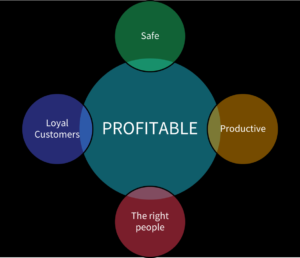
In my model it is crucial to understand what ‘healthy’ looks like in each of the sectors because an increase in costs (an expansion) in any one of them either contracts one or more of the other sectors or eats straight into the profitability. Most organisations can readily tell me what productivity costs them, what customer loyalty costs them and what attracting and recruiting the right people costs them but sadly not many can tell me what ‘safe’ costs them, not safety but ‘safe’.
I often hear things like ‘I only have 25k in my ‘safety’ budget this year’ and I always feel like saying “Jeez, I hope you’ve got a big ‘unsafety’ budget then!” in response. Right now, there are obvious increases in the cost of every other sector in my model and so sadly ‘Safe’ is getting squeezed. Unbefrigginlievable for those out there still flying the flag for ‘Zero Harm’!
The bottom line is the CEO needs to understand the cost of ‘safe’ and I think S.I.F. just might be a vehicle for exploring this very thing.
Identifying our potential ‘People Killers’ is the first step on this journey and it is good to see some papers and organisations espousing the use of the ‘Energy Wheel’ to do this. It helps to focus our attention and order our thoughts and you can find a version of it with a quick google search. It’s a great starting point for any organisation but don’t forget to consider other hazards or hazardous activities unique to your operation. Sadly that’s just about where google’s help (currently) ends.
The sad thing is, when I look around there doesn’t actually seem to be an awful lot out there on ‘Prevention’. There are lots of articles and papers saying how to grade an accident when it has happened from LSIF to HSIF but we all know that when we are proactively assessing risk before the HSIF has hit the fan it is much more difficult to do. Why? Because in today’s era of instant gratification we all want quick and easy and I’m sorry to say, preventing serious injuries and fatalities isn’t anywhere near as quick and easy as creating them.
Who’s Responsible for S.I.F Prevention in the Organisation?
S.I.F. Prevention is not the job of the Safety department – let’s just get that out of the way! It requires continuous management and relentless commitment from everyone but as with most things, it starts with Senior Leadership. Once we have identified our ‘People Killers’ (I call them this for the very reason that it makes you feel uncomfortable when you say it) the next and most difficult part is to agree what we need to do to prevent their potential being realised and yes, there is inevitably cost involved which, if we haven’t allowed for it or don’t plan it appropriately, might contract one or more of our sectors.
Let’s take a moment to speak about the unspeakable – this is when it becomes important for us to understand the cost of a life or a serious, life-changing injury. Knowing this helps us to make sensible decisions based on your own ‘Healthy Tension’ model. Fortunately, for most of us we don’t make a habit of killing or seriously injuring our people and so we have to be able to assess the likelihood and potential frequency of the worst happening.
E.g. do you want to invest 4m in new equipment or technology if the likelihood of a S.I.F. is one life in a 1000 every 60 years and will ‘only’ cost you 350k? Maybe not, however, if you have to spend 4m on rescue vessels to extract 300 people from an oil rig in an emergency and each life costs you 1m and the frequency could be every 10 years, well you might just be writing that cheque pretty quickly.
Obviously, the examples here are straight out of my head so don’t bother fact-checking them and commenting about how stupid I am!
Actually what I have found really interesting, and quite a relief for the clients we have worked on this with, is how little it actually does cost to prevent S.I.F.s in financial terms.
Ensuring that our people are well trained, competent and capable, tightening our hazard controls and monitoring their application studiously, understanding organisational drift, preventing error-likely situations from accumulating, proceduralising the use of error reduction tools where practicable, paying attention to weak signals in our operations and ensuring that our procedures are detailed, accurate and regularly reviewed and amended, all go a long way to preventing the worst from happening and, if you have done a good enough job of truly narrowing down your ‘People Killers’ none of this should be ‘too onerous or difficult’ to do.
If you think you are facing a monumental task to achieve this, you need a clear plan so start with one team or department at a time and facilitate a workshop, start by exploring the Energy Wheel together and discussing the work done by this team or department; then move on to the next. Finally, when you have identified the P.S.I.F.s from every department you can start to look across the board to decide where to start from an Organisational perspective, knowing that each team or department will already be starting to work on their own individual ones.
If you would like help you can of course reach out to us here at G.R.I.T and we would be more than happy to support you.
I would love you to share your ‘Healthy Tension’ models with us and to hear how you are managing P.S.I.F.s or High Potential Events in your organisation. I am absolutely passionate about the work myself and my colleagues at GRIT do with our clients around the World because it truly does save lives and organisations. If you would like to hear more about our work please reach out to me at [email protected]
Teresa Swinton CEO G.R.I.T
About Teresa
Teresa is regular speaker and podcast guest discussing her views on S.I.F and how Leadership styles impact organisation behaviours and outcomes (leaders creates the values and organisation).
She is the the driving force behind G.R.I.T in the U.K, and brings a deep understanding of high-risk industries to her role. Her commitment to instigating meaningful workplace change and her expertise in human performance and leadership development make her a respected and passionate speaker.
 English
  English (UK)